What a forgetting curve can and can't tell you
Forgetting doesn't follow one universal countdown. The curve describes a pattern, while a useful schedule needs more context.
 OOWN team · Oct 21, 2026 · 4 min read

A week without using a word can mean different things. Perhaps you met it once, understood it in a sentence, and haven't tried to say it since. Or perhaps you've recalled it in several conversations over the past month.
Both words have gone a week without practice. You wouldn't necessarily expect the same result when you try to recall them today. Time matters, but the learning history behind that time matters too.
The forgetting curve helps us describe a pattern across a delay. It doesn't give every word, or every learner, the same countdown.
What was on the original curve?
In his experiments on retention over time, Hermann Ebbinghaus learned syllable sequences, waited, and learned them again. He compared the effort required before and after the delay.
The benefit left by the first learning declined more quickly at first and more slowly later. Here, that benefit was measured as savings in relearning. It wasn't a direct count of words he could use in conversation.
That distinction matters when a familiar chart says that you will lose a fixed percentage of new words tomorrow. Ebbinghaus studied particular material with a particular method. His results don't establish one timetable for everyone or every kind of knowledge.
Before interpreting a curve, ask what its vertical axis measures. Time saved in relearning, answers recalled without a hint, and answers recognized among options are different outcomes.
What this drawing can tell you
Modern scheduling models can draw a curve of estimated recall probability. In FSRS-6, that estimate depends on the time since a review and the model's stability estimate, together with its curve parameters.
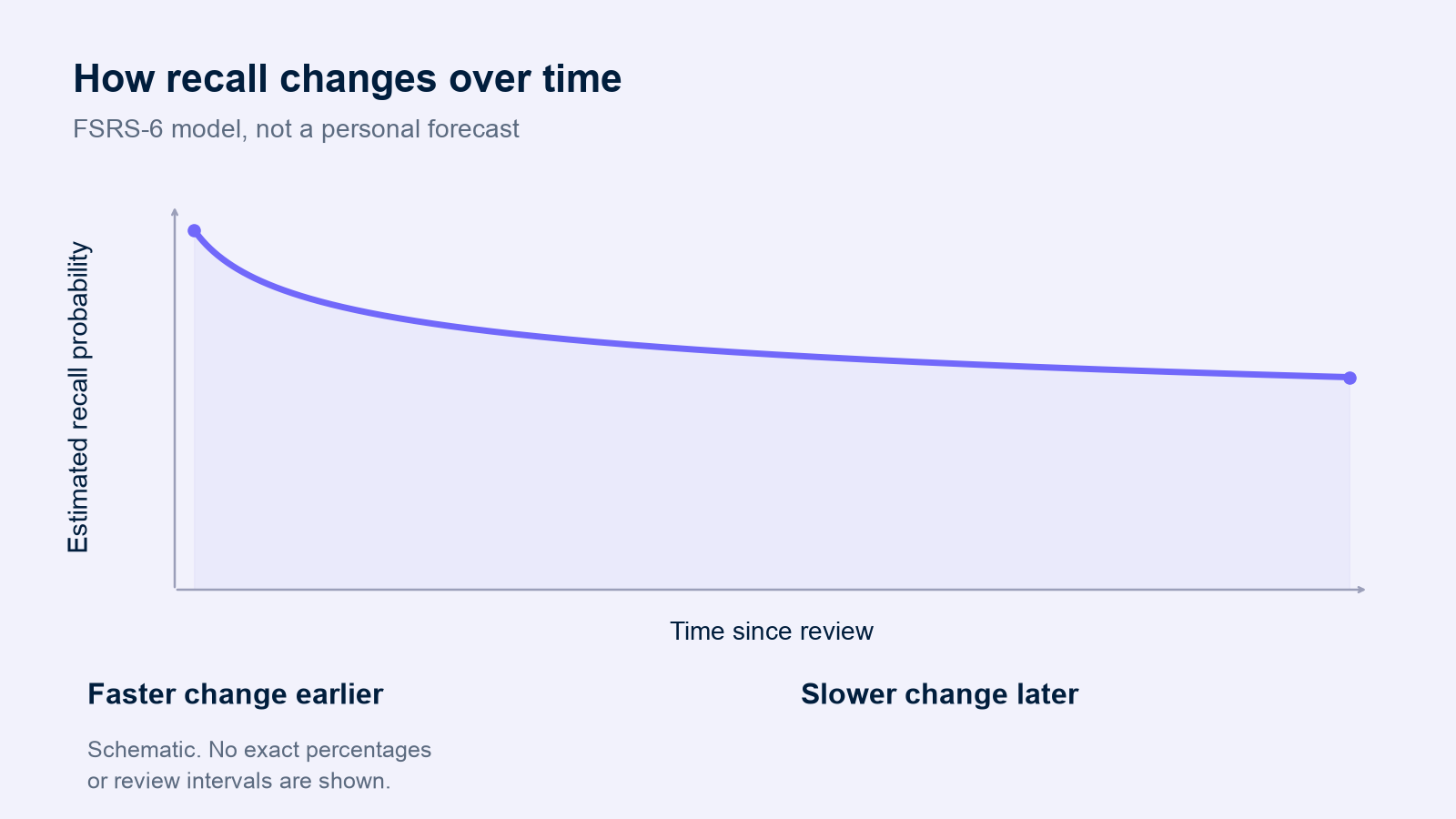
A schematic FSRS-6 model curve, not Ebbinghaus's measurements or an individual forecast. No exact percentages or review intervals are shown.
Read from left to right: more time has passed since the review. The height of the line is the model's estimated chance of a successful answer, and it falls as time passes. In this example, the decline is steeper near the beginning and gentler later.
The smooth line doesn't show a memory physically shrinking inside the brain. It describes an estimate of performance. Your next answer will provide another observation with which to update the model.
Practice changes the history
Suppose you're learning the Spanish word ventana, meaning "window." On the first day, you need to see it several times. Later, you recall it after an overnight break. Eventually, you might recall it after weeks away.
This is an example, not a promised sequence of intervals. Successful recall after a gap gives evidence that the word is accessible across that gap. A schedule that keeps testing it every few minutes would ignore useful information.
A model can represent greater stability by making its predicted decline slower. It updates its estimates after reviews rather than treating every word as if it had just been learned. That doesn't mean every review has the same effect or every answer guarantees a longer interval.
From a curve to a schedule
Knowing that forgetting has a time pattern raises a practical question: when should the next review happen?
One part of the answer is deciding how much risk of a missed answer you're willing to accept. Checking more often generally takes more time. Waiting longer leaves more room for an unsuccessful attempt.
The curve alone can't choose that tradeoff. Nor can a generic drawing tell whether a particular word is already familiar or the last answer was a guess. A scheduler needs evidence from the item's history as well as a model of change over time.
For your own learning, you don't need to turn the line into a calendar. Treat an attempt to recall a word as information, and give an honest answer about what you could recall. One missed word is a new observation, not proof that all the earlier work has vanished.
That leaves a harder problem. A review can help you learn, tell you something about retention, or do both. How does its timing change the value of the time you spend?