When is a review worth your time?
An immediate repeat and a review after a long break provide different evidence. A useful schedule balances practice, recall, and time.
 OOWN team · Oct 21, 2026 · 4 min read

You look at a new word, hide the answer, and say it correctly. A moment later, you try again. Another correct answer. Should the next review now move weeks into the future?
Those attempts may be useful practice. But remembering something you've just seen and remembering it after several days are different tests.
That is the difficulty with timing: a review can help you learn, tell you what remains accessible, or do both. Its value isn't measured only by how easy the answer feels.
Early practice has a job
If you've just encountered an unfamiliar word, repeating it soon can help you learn its sound, spelling, and meaning. You may need several attempts before you can recall it at all.
The limit is what an immediate success proves. An answer recalled just after seeing it may still depend heavily on that recent presentation. It doesn't test the same thing as recall after a substantial pause.
You don't need to avoid early practice. You need to distinguish getting started from finding out what survives a gap. One easy answer is not a certificate of long-term learning.
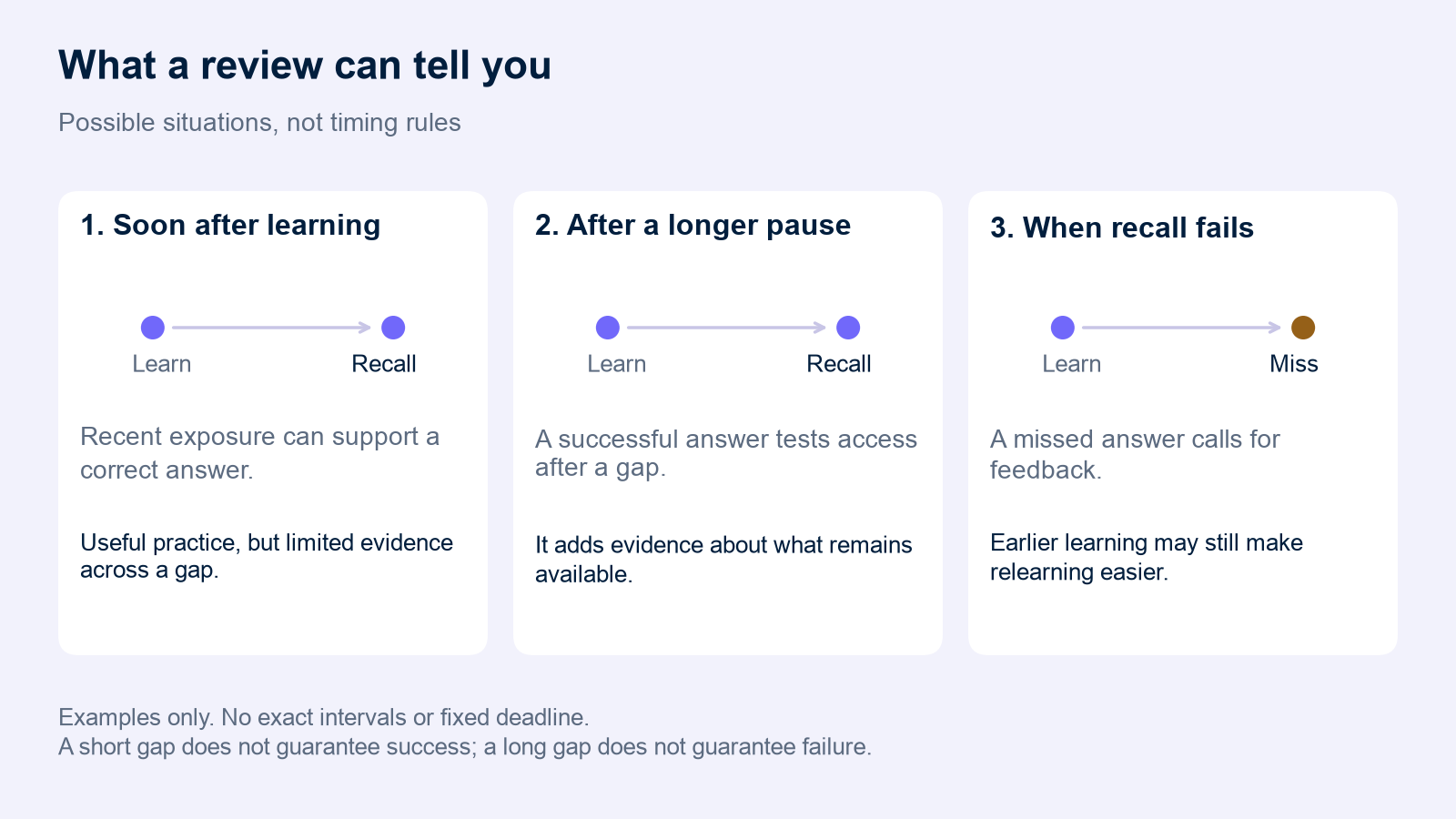
Possible review situations, not a rule that a short gap means success or a long gap means failure. Early practice can help; a missed answer can guide what happens next.
A late review still has value
Now suppose the word returns after a long absence and you miss it. The result is informative, but it doesn't by itself prove that the schedule was wrong. A prediction that allows some chance of forgetting also allows occasional missed answers.
Nor does the error mean that every benefit of learning has disappeared. A hint might bring the word back. Learning it again may take less effort than the first time. A missed answer is something to use, not a judgment on your ability.
The cost is practical: you may need to spend more of the session restoring access. Check the answer, notice what was missing, and let the result inform the next review. Missing the scheduled day is not a reason to abandon the word.
Delaying further isn't automatically better, either. In a study of spacing and later recall in which people learned facts, the most useful study gap depended on how much later the final test occurred. Longer gaps did not keep improving the result indefinitely. This does not supply a universal interval for your vocabulary.
Choosing a tolerable risk
The phrase "review just before you forget" suggests a precise deadline, as if a memory had an expiration time. A scheduler cannot observe such a moment in advance.
FSRS works with estimates. Its desired retention setting specifies a target probability of successful recall at the scheduled review. A higher target generally means shorter intervals and more review work, as the Anki manual's explanation of FSRS describes.
The target is a planning choice, not a guarantee for a particular word. It doesn't mean that a fixed share of your vocabulary has been learned permanently. Here we're describing the scheduling principle, not promising a particular setting in OOWN's interface.
When a review is late, the elapsed time and your next answer still provide information. The schedule can use what actually happened rather than pretend that you answered on the original date.
Useful timing depends on the item
An obvious word and a confusing word don't need identical treatment. Your available time matters too. Trying to keep every item almost perfectly accessible can create more review work than you can sustain.
For your next session, try a simple distinction: did you recall the answer yourself, need a hint, or need to see it again? Report the result honestly. Then consider the workload across sessions, not just the satisfaction of getting everything right today.
A useful schedule balances practice, evidence across a gap, and work you can return to. It doesn't ask you to identify the perfect second before you would forget a word.
The obvious next step is to write a calendar: tomorrow, three days later, next week. But a calendar needs a way to notice when two words stop following the same pattern.