The three estimates behind an FSRS review
Difficulty, stability, and retrievability help FSRS turn a review history into an estimate of when to ask again.
 OOWN team · Oct 21, 2026 · 4 min read

Your route home may remain familiar through a long vacation. A new access code might not come back to you after the weekend.
The same person holds both memories, but a useful schedule would treat them differently. FSRS describes those differences with difficulty, stability, and retrievability, usually abbreviated D, S, and R.
Difficulty and stability describe the stored state of an item. Retrievability is calculated from stability, the time since the last review, and curve parameters. These are model estimates, not direct measurements inside the brain. Keeping their roles separate makes the next review date easier to understand.
Difficulty concerns the item
Difficulty estimates how hard it is for this item's stability to grow through review. In FSRS, it is bounded between 1 and 10.
It isn't a measure of your intelligence or the objective complexity of a word. A common word you confuse with another may be difficult for you. A rare word with a memorable association may be easier. These are examples, not a rule that rare words are easier.
The estimate can change after a new rating. It gives the model a way to represent persistent differences between items, while leaving room for those estimates to be revised.
Stability describes a timescale
Stability is defined as the interval at which predicted recall probability reaches 90%. If an item has a stability of ten days, the model predicts a 90% chance of recalling it ten days after review. Ten days is an example, not a suggested interval for every new word.
That definition gives stability a consistent unit of time. It remains the same definition even if you choose a different desired retention target for scheduling. Stability is not automatically the next interval: the target also matters.
After a review, the model calculates a new stability. The result depends on the previous state, the rating, and the relevant review conditions. Successful recall after a substantial gap can support a different estimate than success shortly after seeing the answer.
Retrievability changes as time passes
Retrievability is the predicted probability of a successful answer now. As the time since review grows, that probability declines according to the model's forgetting curve. With the same curve parameters, higher stability makes the decline slower.
Between recorded reviews, time can change the calculated R without another answer being entered. That doesn't mean the system is recording a new failure each day. It is calculating the current probability from the existing state.
The forecast concerns performance. A prediction of 90% still permits a missed answer. It also doesn't promise identical results across different kinds of questions or all the situations in which you might need a word.
The official algorithm reference gives the definitions and formulas behind these estimates.
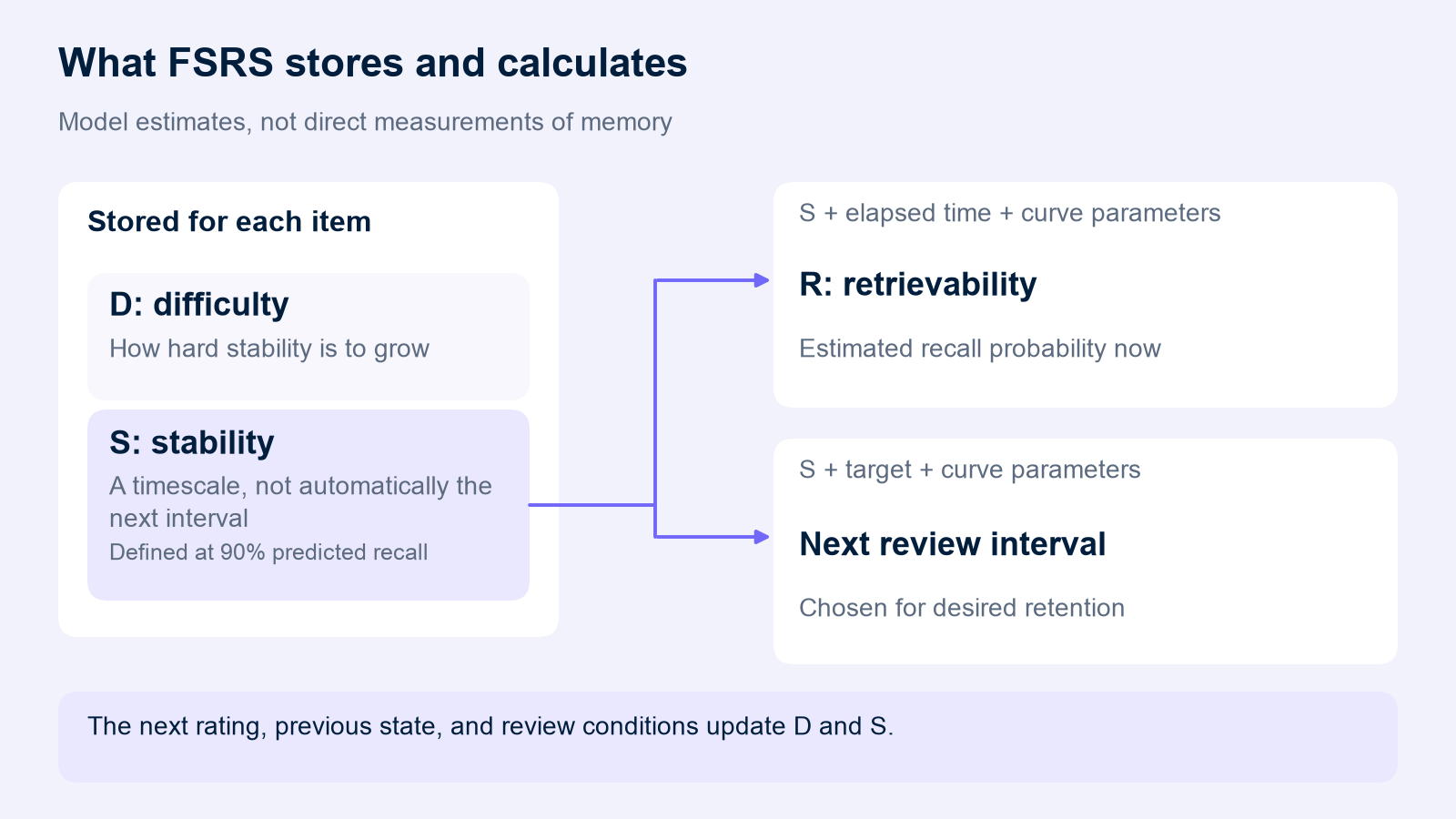
Stored state and two calculations. R is calculated, not independently stored. The next interval uses S, the target, and curve parameters.
The target chooses a point on the curve
Desired retention is a scheduling preference. The model finds an interval corresponding to that target probability, subject to the application's scheduling rules.
A higher target generally brings reviews closer together. A lower target allows longer gaps and more risk of forgetting. The Anki manual's FSRS guidance explains why increasing this setting also increases the workload.
The target and stability answer different questions. Stability describes the model's current estimate for an item. Desired retention expresses how conservatively you want to schedule its next review.
For the same stability and curve parameters, choosing a target above 90% gives an interval shorter than stability. Changing the target doesn't redefine what S means. This describes the model, not a promise that every app exposes the same controls.
When a review date looks surprising, separate the questions: what does the model currently estimate, and what target is it scheduling for? Neither the date nor an isolated missed answer is a verdict on your ability.
Those definitions give FSRS a useful vocabulary. The version of the algorithm determines exactly how the estimates are updated. In FSRS-6, two changes deserve particular attention.